
THIS is why you plant natives. Even if you didn’t appreciate the fact that native plants are a huge chunk of a healthy, well-oiled ecology, you’d let the natives that spring up uninvited stay. Because of the magic of the wildlife. Native plants bring in all those things you see on the Discovery channel, but thought had been eradicated by DDT and suburban sprawl. You don’t even have to plant it. Just let ‘em go and they will come.
For example, I went out early one morning a couple of years ago with Rose, our black lab. Often while I’m waiting for her to finish her morning ablutions and her interminable search for snacks in the surrounding fields, I use the time to weed a little. But this time, I stopped at the six-foot tall stand of wild white aster (Asteraceae), caught by the sight of a mid-sized bumblebee attached to the underside of one of the topmost flowers. He (she?) was sound asleep. I realized as I looked at the froth of flowers that the plants – volunteers all — were filled with sleeping bees. And not just one species. There were several different bumble-type bees, a few carpenter bees of which we have an overabundance, honeybees, and some other bees I’m too ignorant to i.d. (Sadly no blue bees, which I had seen sleeping on the undersides of the raspberry leaves earlier in the season.). I dragged my husband, Gary, out to see.
“I thought bees all went back to their hives, or their tree stumps or the ground or the main support in the garage or whatever for the night,” he said, peering at one small bloom to which two different kinds of bees clung upside down. “It looks like they all fell asleep in the cafeteria.”
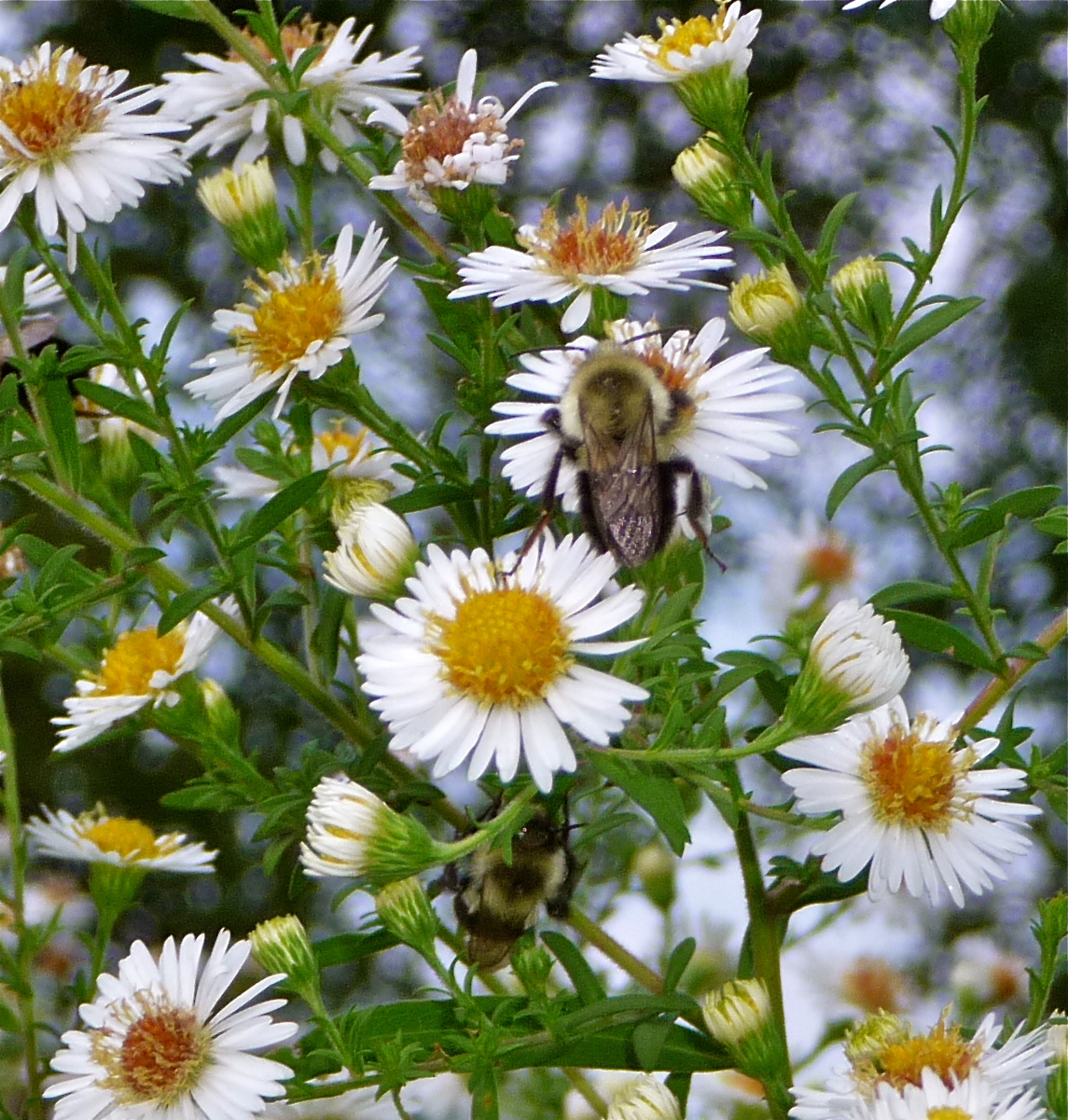
The bees’ falling asleep in the cafeteria is apparently not that unusual; the link below will take you to a photo of a bee slumber party in a sunflower bloom. Watching the sun slowly warm and gradually wake the mixed-Apis crowd, I was not only delighted in a kind of ‘aw ain’t that cute’ way — sleeping bees are as cute as sleeping puppies though you’re not tempted to touch them. But I was struck by the democratic clustering of the different species. I’ve seen a pair of same-species bees crawl contentedly over each other on a single bloom, but object or leave in a huff when another species comes in to feed. But these were all ecumenically bedded down together as though at camp. Perhaps this is preaching to the choir — usually people who read garden articles are already entranced with bees and other pollinators — but even if I am, it’s nice to know we’re all in the same church.
http://homeofthebudds.typepad.com/homeofthebudds/2009/08/do-bees-sleep.html
 Nancy Taylor Robson