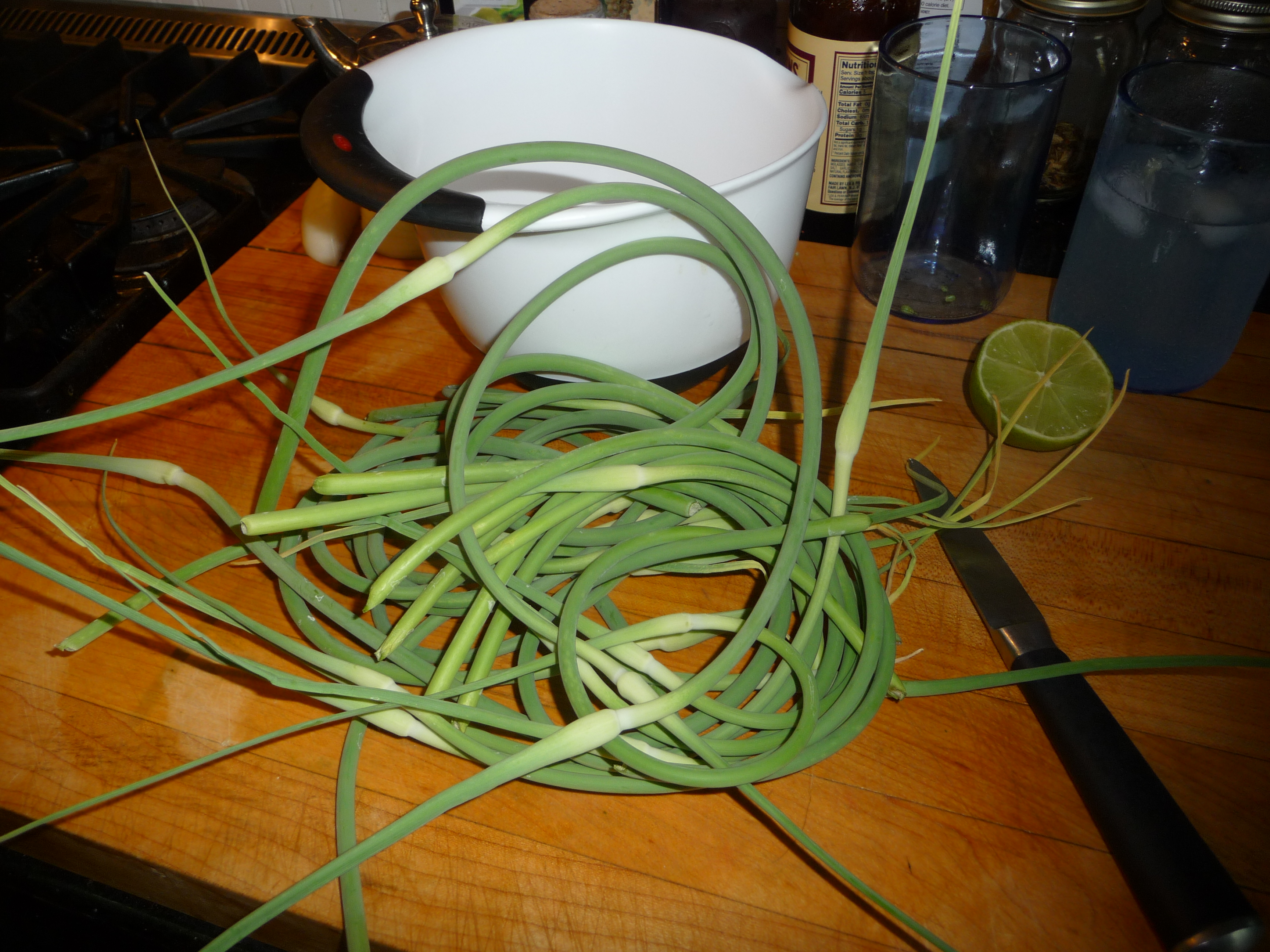
Got Garlic Scapes?

Scapes before clipping off arrowhead tip

I just noticed them a few days ago – they kinda hide in all the leaves that the hardneck garlic has sent up over the last two months. But then I caught sight of one of those green, downward curling stems with its barely-yellow arrow-pointed head and realized: It’s time to cut the garlic scapes.


Scapes in tempura batter
Scapes in tempura 


In addition to the cluster of green leaves of virtually all garlic types, hardneck garlic has a bonus that the softneck varieties don’t. Scapes. The scape is the curling green top of the central stem, which is the hard neck. The scape is beautifully edible if you get it before the arrowhead at the tip swells. Left alone, the tip of the scape grows tough and reedy and produces a cluster of tiny little bulbils like teeny onions that can, if planted, eventually become new garlic bulbs in two years, but that project also draws energy off the task at hand: growing big juicy garlic bulbs below.  Plus, if you clip off the scape early (as I did last week), at the point of the plant where it just begins to curl, it’s green and crisp, and you can cook it in a variety of ways.  Win-win.

Scapes, peppers and carrots frying


The scape imparts a garlic-y flavor that’s a lovely addition to omelets, soups or stews. Oil each a little and  stick ’em on the grill for a few minutes as we did a few nights ago (I forgot to photo, sorry), or tempura the thing for an hors d’oeuvre. (THAT, I remembered to photo along with the gin and tonics we had with them). Life is good.


TEMPURA:


Batter:

About a cup of flour, a little salt and enough soda water to make it a slurry about the consistency of crepe batter.  I also sometimes use beer for the liquid instead of soda, which adds flavor (the alcohol burns off). 


Clip off the arrowhead tip, which is reedy, then cut the scapes in half for easier handling. Pour about an inch and a half of oil into an iron pan, an electric fryer or whatever else you have. The oil needs to be 375F as measured on a candy thermometer. If you haven’t got one of those, wait until the oil is very hot before putting several dipped scapes into the oil.* They only take a couple of minutes to cook. Drain them on paper towels.  Munch. My husband, Gary, who loves fried stuff as much as I do, cut up some carrots and a pepper to tempura as well. Yum yum yum.

Tempura'd veggies
Tempura’d veggies


*Be very careful; the oil can spit, and if you have ANY water on your hands that drops into the pan, it can splatter.  (Aloe plants in the kitchen are a help). 


Published by Nancy Taylor Robson

I grew up sailing and building boats with my dad, married a tugboat captain, (who I'm still happily married to) and embarked on a life of adventure, challenge and fun. My first book, Woman in the Wheelhouse, told the sometimes harrowing story of working on an old coastal tugboat as cook/deckhand then worked in Mexico in the Campeche oil fields on a supply boat. I was one of the first women in the country to earn a tug operator's license. I'm the author of three other books, Course of the Waterman, which won the Fred Bonnie Prize for the novel, the historical novel, A Love Like No Other: Abigail and John Adams, A Modern Love Story, and OK Now What? A Caregiver's Guide to What Matters, which I wrote with longtime RN and hospice nurse, Sue Collins during the time my mother-in-law was moving to the end of her life. My second, Course of the Waterman, the coming of age novel of a young Eastern Shore waterman, won the Fred Bonnie award in 2004. My third book, second novel, A Love Like No Other: Abigail and John Adams, A Modern Love Story, takes readers into the lives of the new nation's strong-willed second First Lady and her stubborn, often-absent and adored husband, John, our second US President. I wrote the book because I'd spent big chunks of time raising children alone while my husband was at sea and felt an affinity for Abigail, but also looked to her life as a MUCH bigger challenge that informed and encouraged my own. My fourth book, OK Now What? A Caregiver's Guide to What Matters (Head to Wind Publishing, 2014) was written in collaboration with Sue Collins, RN and longtime hospice nurse and has received heartwarming feedback on how helpful it's been to many caregivers. A freelance writer for many years, I've published personal essays, features, maritime reporting and analysis, travel, garden and more for such places as The Washington Post, Yachting, House Beautiful, The Baltimore Sun, the Christian Science Monitor, Southern Living, Sailing, and more. I'm also a University of Maryland Master Gardener who grows and cans the family's fruits and vegetables, and a Bay-Wise program certifier. I write, sail, race sailboats (occasionally), walk the German Shepherd dogs, and cook for friends and family.

Leave a comment