by Nancy Taylor Robson
Published in 2013 by GWA (now GardenComm) the national garden communicators’ association

Nativar, a term coined by University of Georgia horticulturist Dr. Allan Armitage, has something like cult status among gardening cognoscenti.
“There’s a huge discussion about it,” says Jillian Zettig, horticulturist and landscape designer at Johnson Nursery in Menomonee Falls, WI.
Derived from mashing together ‘native’ and ‘cultivar’ (which itself is a combination of “cultivated variety’) the term nativar refers to a cultivar of a native plant species. Armitage says he coined it to signal to his daughter the connection between native parentage and cultivar offspring.
“Whether natural or manmade in the world of the native plant – Rudbeckia, Coreopsis, Gaura – I wanted to let her know it’s a cultivar of a native plant,” Armitage explains.
What exactly is a nativar? According to Grace Chapman, Director of Horticulture at Lewis Ginter Botanical Garden, nativars are: plants that have adapted from the straight species; that are either a natural cross pollination or a natural mutation; that are the result of a human-made cross pollination; or are genetically modified plants. Abreeder starts with a native plant then selects to change specific cultural qualities or enhance a plant’s aesthetics.The ‘new and improved’ versions of natives help to sell the idea of native plants to landscapers and gardeners, who are often looking for a visual POP! that native plants don’t always deliver.
“They’re the ‘WOW’ plants of our native flora,” says Mike Yanny of Johnson Nursery in Menomonee Falls, WI. “They were selected for some characteristic or combination of characteristics that make them superior to the average seedling. For instance, Carpinus caroliniana‘J.N. Upright’, Firespire® Musclewood was selected for having extraordinary orange-red fall color and an upright, barrel-shaped form.”

While native plant purists aren’t always sold on the idea of nativars, Armitage insists that they have an important function in horticulture.
“The native plant movement is terrific, and especially for those who are doing reclamation work and ecological replanting,” he says. “However, if we take that native plant movement into the real world of landscapes and gardens, then cultivars must be considered if the native plant movement wants to make native plants more mainstream.”
Landscapers and designers usually weigh aesthetics heavily, and nativars tend to outshine their native parents in the looks department. But the term nativar also implies that it carries a genetic bonus bestowed by its native parent.
“The huge advantage of anything derived from native species is its potential adaptation to new circumstances,” says Dr. Donald Falk, professor of natural resources and restoration ecology at University of Arizona.
However, an individual nativar may or may not be endowed with the same adaptive gifts as its forbear.
“The [aesthetic focus] has nothing to do with tolerating or being a productive member of the environment,” says Dr. William Bauerle, plant physiologist at Colorado State University in Fort Collins, CO.
“Cultivars lack genetic diversity,” says Dr. Sara Tangren, founder of Chesapeake Natives Nursery, who taught environmental policy at Johns Hopkins. Tangren says that nativars have distinct, well-defined traits that are reliably reproducible because genetically, the nativar is usually many copies of an individual, which can be an ecological shortcoming.

“The key to surviving changing times like ours is to have a reservoir of genetic variability,” says Falk. “In the restoration field, people are really aware that native species probably have adaptations in their gene pool that … could become important to the species’ survival as well as that species’ contribution to the ecology as a whole.”
Another factor to consider in the nativar equation is ecotype, something Yanny feels strongly about identifying to a customer.
“People who are selecting that nativar to benefit the ecology need to pay close attention to the ecotype as well as the provenance (the wider native region of the original species) to make it really useful,” he says. “Different ecotypes of a single species can even vary within as short a distance as 20 miles apart.”
Ecotypes are native plants of a given species that have evolved in and adapted to the demands of a specific region (along with that region’s plant and animal populations). For example, the North American Aster is native to most of the eastern US. Yet the ecotype from Montgomery County, MD that Tangren grew without irrigation during a drought-stricken year was three times the size with five times the bloom of the same species that grew beside it whose seed had originated in Erie County, NY. The Montgomery ecotype was much better adapted to the ravages of a Maryland summer than the northern ecotype.
So are nativars productive members of a sustainable landscape?
“It’s a premature question,” says Dr. Doug Tallamy, University of Delaware entomologist and author of Bringing Nature Home(Timber Press, 2009). “When I talk about the effect of a cultivar on the productivity of that plant, I’m talking about food webs, which means more than pollinators. For example, is it going to change the number of caterpillars [a key protein source for baby birds] that it can produce? You can affect pollinators without affecting caterpillar production. A change in leaf chemistry can end up poisoning caterpillars,” he explains. “And if you take any flower and increase its size, you’re messing with the flower energy budget so there will be less for production of pollen and nectar. Or if you change color pattern, some specialized pollinators won’t be able to find it. These are all guesses, and it all needs to be measured.”
How nativars do or don’t fit into a sustainable landscape is a question that has no definitive answers based in research – yet.
“Everyone’s asking the question,” says Tallamy, “but the research hasn’t been done, though it looks like Mt Cuba is funding [University of Delaware] to do some of this research.”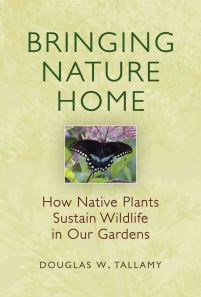
 Nancy Taylor Robson