Chestertown Middle School Wins Special Consideration

Chestertown Middle School Gardeners

Sabine Harvey, Master Gardener coordinator and gardener extraordinaire, submitted the Chestertown Middle School Grow It Eat It garden she spearheaded with the kids this year to Mother Earth News’s Fabulous Food Garden contest. The garden, among about 100 (if memory serves)  submitted to the contest, was grown behind the school, and provided not only some terrific meals for the budding veggie gardeners, but fresh vegetables for the Kent County Food Pantry. While it didn’t actually win, it can darned close and impressed the judges so much they created a second prize: they’ve become runner-up and the garden is garnering $100. Well done Sabine and all the young gardeners!

Read more:

http://www.motherearthnews.com/grow-it/fabulous-food-garden-contest-winners-zb0z1112zrog.aspx

http://www.chestertownspy.com/sabine-harvey-master-gardener/

Slow Money: Like Buy Local But Invested

“Slow Money” is the name for a movement started by socially conscious investing pioneer and author,

Woody Tasch, author of Slow Money

Woody Tasch. …Slow Money is dedicated to connecting investors to their local economies by marshaling financial resources to invest in small food enterprises and local food systems.

Tasch’s vision for Slow Money, now not just a concept but also a non-profit organization, seeks nothing less than a complete overhaul of the way we think about and spend our money, channeling much more of it into producing healthy local food, strengthening local communities instead of multinational corporations, and restoring our flagging economy in the process. Instead of venture capital bankrolling far flung high tech start-ups, Tasch hopes to see “nurture capital” funding local merchants and producers who, in turn, plug half of their profits back into their communities, ensuring one small local virtuous circle that values soil fertility, carrying capacity, a sense of place, care of the commons, diversity, nonviolence, and cultural, ecological and economic health as much as financial return. Tasch hopes to get there by persuading a million Americans to invest at least one percent of their assets in local food systems by 2020.

 To read more:

http://www.emagazine.com/earth-talk/what-is-slow-money/

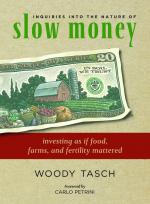
Slow Money (Chelsea Green Publishing $21.95)

http://www.chelseagreen.com/bookstore/item/inquiries_into_the_nature_of_slow_money:hardcover

A Little Something for the Holidays

It’s just not Christmas until I hear the Hallelujah chorus by Georg Frideric Handel. The chorus, Handel’s musical tribute to the Messiah, was performed for the first time at Easter, 1742, not Christmas.

Georg Frideric Handel 1749. b.1685 d.1759

No matter. It’s a moving reminder of what the Christian portion of this holiday season is actually meant to be about. Seeing it in unlikely places — malls and food courts, where we’re urged to spend spend spend to make ourselves and our families happy and to boost the consumer economy — is both a timely and poignant reminder of the spiritual food and the sustenance of faith that we all crave.

http://www.youtube.com/watch?v=wp_RHnQ-jgU

 http://www.youtube.com/watch?v=3M3y2YD6Qy4

Leftover Days That Follow

While I love the meal of Turkey Day – mash, gravy stuffing, what’s not to love? – I actually like the days that follow more.  The meal itself, fairly hidebound in tradition, offers limited scope for creativity, but the day after, you can have at it with abandon. It’s like the difference between a formal ball and a hoedown.

The possibilities with leftover turkey are almost endless:  hot curried turkey salad, cold turkey salad with scallions, apples, toasted walnuts and celery, turkey croquettes with mornay sauce, plain old turkey sandwiches with a big slathering of garlic mayo on rye bread with sliced sweet onion and a beer (Dogfish Head Raison D’Etre), turkey and mushroom crepes with thyme, sautéed shallots and smoked gouda sauce, turkey wraps with lettuce, scallion, avocado and chipotle sauce, turkey tetrazinni, turkey pot pie and turkey soup.

This year, I must confess, that my turkey, stuffed and roasted (of COURSE with the stuffing inside the bird, we did it for years and no one has died of it yet!) wasn’t that great.  I don’t know whether it was the bird, which was free-range, organic, local and fresh, hitting all the foodie hot buttons, simply wasn’t flavorful. OR, whether I simply didn’t do enough to help it along. My sister-in-law’s turkey ( see previous post) was superb, flavorful, crisp-skinned, moist and absolutely delicious, was brined and fretted-over, so maybe I need to do some brining and more fretting for the next bird.

My sister-in-law, who flies out tomorrow, was handing over leftovers like door prizes as we walked out the door last night. Matt got the turkey carcass and gravy. With that, he will make one heck-of-a-stock. Which should always be the first order of culinary business the day after Thanksgiving.

To make stock, take whatever remains of the truly useable meat off the bone and throw the carcass into a big stockpot with every odd little bit of meat, skin, bone and fond (the gorgeously flavorful bits stuck to the bottom of the roasting pan that you get out with a little boiling water and wooden scraper) including the wing tips, and some leftover gravy.  Throw in carrots, celery, onion, a leek if you’ve got it, parsley, thyme, a sage leaf and plenty of water. Simmer it for a couple of aromatic hours on the back of the stove. (Want to sell your house? Have a pot of stock simmering when potential buyers arrive. Who can resist a house that already smells like home?).

Then, once the stock is going, assess. How much meat is left and in what configuration? Plenty of thin slices?  Perfect for turkey reubens, wraps, turkey sandwiches with cranberry chutney on whole grain bread, turkey-and-bacon club sandwiches, turkey and wild rice salad with nuts and dried apricots lightly doused with orange-and-mustard vinaigrette.

Little bits of wing meat, the oysters off the back and maybe some streamers of thigh in the bottom of the pan?  Turkey hash with finely chopped sautéed potatoes, sweet peppers and onion, maybe a little cayenne and a fried egg on top. Or curried turkey ragout with sautéed onion, celery, carrot, potato with peas added at the last minute, seasoned with curry and Worcestershire. For wonderfully retro croquettes, chop turkey very fine, grate some onion, and wrap it in a stiff béchamel made with a little milk and turkey broth. Shape them into patties or the classic little anthill-shaped mounds, roll them in bread or cracker crumbs and fry in a little oil. Dress them up with mornay sauce (thin béchamel/broth with grated gruyere and maybe a splash of white wine). Or use virtually the same beginnings and turn it into a turkey soufflé.

If there are bigger pieces, something that can be cut into chunks, it’s turkey salad of some kind – hot and curried with French’s Fried Onion Rings, almonds, water chestnuts and yogurt/mayo dressing, or cold salad with toasted nuts, parsley, apples, grapes and scallions dressed with balsamic vinegar and olive oil.

But my favorite, I think, is turkey pot pie. I do a fairly classic version, adding flavor not by adding tons of salt but by cooking the vegetables in rich turkey stock seasoned with celery tops, thyme and tarragon. After straining out the barely-tender veggies, I thicken the vegetable-and-herb-infused broth slightly to make the sauce. I usually buy the crust, since I can’t make one any better than Pillsbury.

Yet even with a store-bought crust, there’s something distinctly comforting about pot pie.  It catapults me back to childhood, to a time when it felt like the world was filled with attainable riches. A good life could be had in exchange for effort and an appreciation of the simple pleasures.

Served on a Friday evening by the fire, turkey pot pie is the reassuringly low-key end to a fraught week. Brought to a candlelit table, its crust the golden color of a beach at dusk, the juices just starting to rise up and drip tantalizingly down the side, and banked by a good sauvignon blanc, it’s downright elegant.

Turkey Pot Pie

1 pie crust

1 cup cooked turkey, cubed

¾ cup carrots, sliced

¾ cup onions, chopped

¾ cup potatoes, cubed

1 cup frozen peas

¼ tsp dried tarragon

¼ tsp dried or fresh thyme

1 ½ cups rich turkey stock

4 tblsp corn starch dissolved in 4 tblsp cool water

salt and pepper to taste

Cook the carrots, potatoes and onions in the turkey stock gently until barely fork tender. Dip out the vegetables and put into a casserole or soufflé dish along with the frozen peas and the cubed turkey. Lightly salt and pepper the veggies and meat. Taste the stock for seasoning. Put thyme and tarragon in the stock and bring to the boil. Dissolve the cornstarch in the cool water, and whisk into the boiling stock. It should thicken and turn clear in a matter of a moment. Once it’s thick and clear not cloudy, pour over the vegetables and meat. Top with a crust. Put a few slits in the crust. (As one of the characters in the John Wayne movie, The Cowboys, said: Cut three slits in the top –two to let out the steam and one more because your mama said so).  Bake at 375F for 35 minutes or until the crust is browned and completely done.

http://www.epicurious.com/recipes/food/views/Turkey-Potpie-with-Cheddar-Biscuit-Crust-240566

http://www.hellmanns.us/promotions/therealfoodproject/recipe_collection.aspx?Category=SandwichesWraps

http://www.hellmanns.us/promotions/therealfoodproject/recipe_detail.aspx?recipeid=11641&version=1

http://www.foodnetwork.com/recipes/michael-chiarello/next-day-turkey-soup-recipe/index.html

Giving Thanks on Turkey Day

Imagined meeting of Pilgrims and Samoset

Complaining about the cooking to be done for Thanksgiving has gotten to be something of a national pastime; more and more blogs and advice columns offer commiseration larded with helpful hints on ways to circumvent what they consider the ‘worst’ of it. And indeed, if I had a family who sprawled on the sofa while I, who work too, did all the heavy lifting, I’d be supremely pissed (as in: majorly annoyed, not overly-lubricated, though if unhelpful couch potatoes were what I was facing, I’d probably be that too!). But I’m not. My family cooks. All of us, in our own kitchens and together in a single milling throng on the actual day. Additionally, I’m married to a Provider, a forager in field and stream, who ran out at 0-dark-hundred this morning with his enthusiasm and his shotgun and came home with dinner.

Additionally, I grow and then put up a large portion of our vegetables and some fruits — a labor of love, but a labor nonetheless.  It makes me mindful of the luxury we have in the country at this country at this point in history.

I stand in a kitchen that has heat, running water, an embarrassingly well-stocked frig, and a stove and oven that turn on and off at will, and reflect, with a combination of awe and humility, on those who sat down with what must have been enormous gratitude at whatever makeshift communal board for the first Thanksgiving to share a meal that they had foraged, grown, snared, shot and prepared. It was a labor of love, but also an act of survival in a tenuous time.

Wild American Turkey

The contrast between then and now is sharp — when we think of it. Which is the key. Gratitude is conscious, knowledge of what we have contrasted with what could be.  I understand that not everyone likes to or wants to cook. But for that one meal each year, the one that should take us back not only to the food that was on that makeshift communal table, but what the food cost the Pilgrims and Indians in skill, energy, patience, determination and hard work to put there, together, in the face of an always uncertain future, there should be no complaints.

Uuuuuummmm, Cauliflower…..

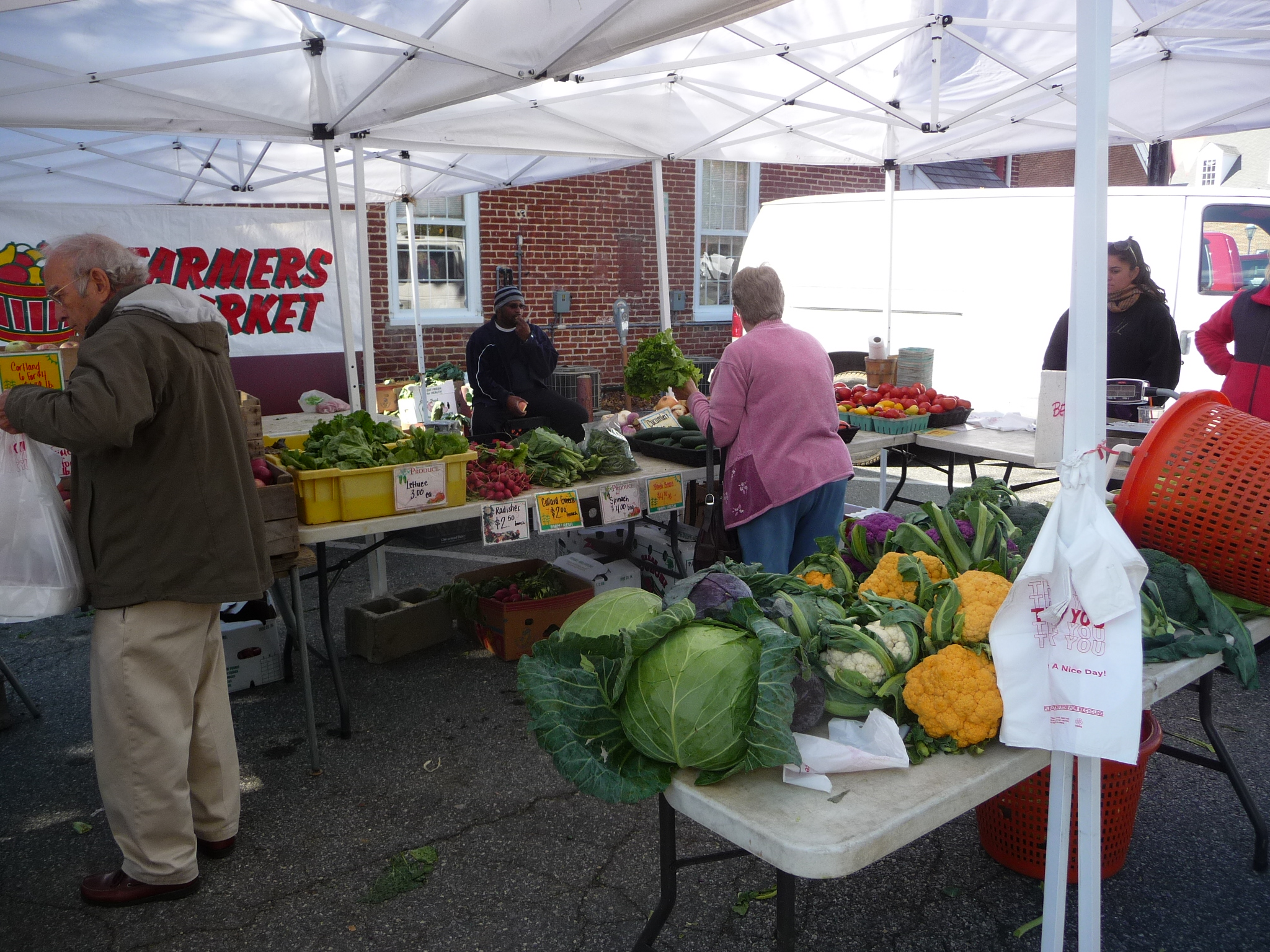
October at the Chestertown Farmers' Market

I always figure if you have cauliflower in the frig, you’ve got dinner.  I realize not everyone sees it that way. I ran into a friend at the Chestertown farmers’ market last week. I was carrying a cauliflower the size of a bowling ball that I’d bought from Lockbriar Farms — a great find from my point of view — but Anita wrinkled up her nose a bit when I showed it to her.

“I don’t like it that much,” she confessed – if confessed is the right word to use in our let’s-all-eat-healthy-and-love-local-veggies-mindset – yeah, confessed is the right word for it. “A little cauliflower goes a long way with me,” she said, still staring at the massive crucifer I was hugging.  “What do you do with it?”

“Stir-fry it with tomatoes and celery and curry, cauliflower soup with mushrooms and shallots and gorgonzola, roast it with parmesan and garlic, steam it for lunch  with hot pepper cheese, layer it with beans and sautéed peppers some white wine and gruyere and buttered crumbs  and run it under the broiler, eat it raw with something sinful like spinach veg dip…”

“Oh!”  she laughed. “You REALLY like cauliflower!”

Yeah.

I love its raw crispness, I love the shape and texture of the head itself – curds some people call them, but that grosses me out, like the curds of clabber (aka curds and whey) my father used to make on the windowsill. I love cauliflower’s vitamin and mineral boost – huge vitamin C, plenty of K, folate and fiber, and more. There are now purple and cheddar cheese colored cauliflower varieties that have only mildly discernable differences in flavor to my palate (though the purple ones come closer in flavor to their brassica cousin, broccoli), but each is superb and superbly versatile.

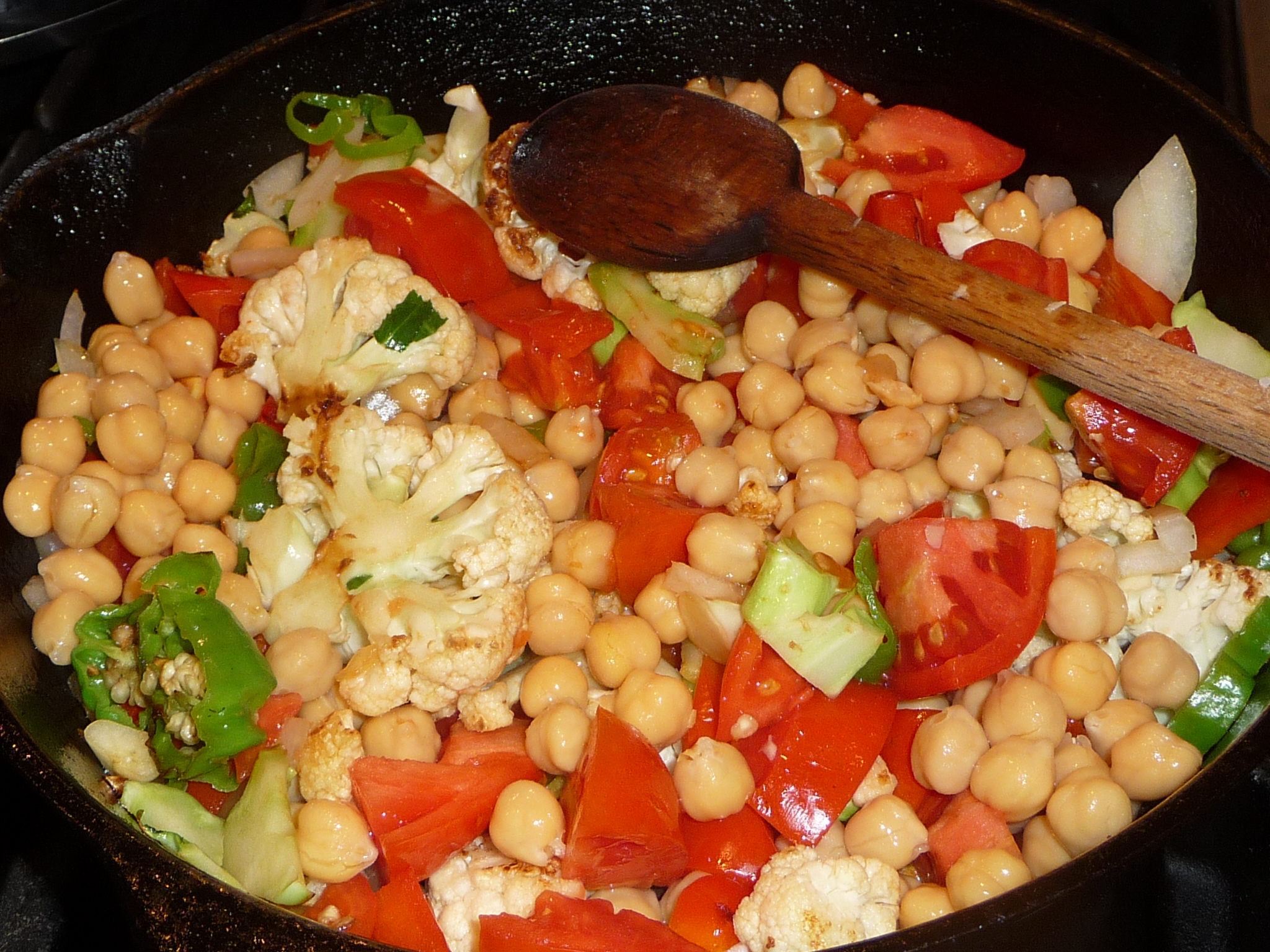
Cauli stew with tomatoes, garbanzos and mild habaeros

I don’t just like cauliflower; I LOVE cauliflower (as one young friend corrected me when I asked about his fondness for snakes).  Mostly because it’s the basis for one of the best and easiest-to-make comfort-food meals of all time. Cauliflower gratin.  Like mac and cheese but better for you and quicker – it takes about 12 minutes start to finish.

CAULIFLOWER GRATIN

 1 medium head of cauliflower

3 tblsp sweet butter

3 tblsp flour

1 ½ cups of milk, anything from whole to skim

1 ½ cups of fresh-grated parmesan (use the real stuff; it makes all the difference)

salt, pepper and nutmeg

Put the cauliflower whole into a pot with about an inch of water and steam-boil it until just tender but not falling apart, which will take about 8 minutes. Meanwhile, make a roux. Melt butter in a pot, stir in flour and cook for a few minutes. Whisk in a cup of milk until smooth. This will be thick. Add salt and pepper and a dash of nutmeg, about a ¼ tsp.  Add more milk if the béchamel is too thick – it should be about as thick as a smoothy right now. Add more milk if you need to thin it some. Whisk in a ½ cup grated parmesan.

As soon as the cauli is just-done, take it out of the pot, otherwise it will get too soft, and break it into pieces in a gratin dish or oven-proof dish of some kind. But be sure you save the boiling water. Add some of the water from the boiled cauli to thin the bechamel and add flavor. It should now be the consistency of good rich cheese sauce. Pour the cheese sauce over the cauliflower, covering everything. (Enrobed is the way some of the more hopefully pretentious restaurants used to describe this.) Then cover that with about a cup of grated Parmesan cheese and run it all until the broiler until it’s browning and bubbly. Serve with a bottle of rich red wine. Heaven.

http://www.bigoven.com/glossary/Cauliflower

http://simplyrecipes.com/recipes/roasted_cauliflower/

http://www.101cookbooks.com/archives/simple-cauliflower-recipe.html

http://thepioneerwoman.com/cooking/2009/01/cauliflower-soup/

Thanksgiving Cookpamphlet for the Uninspired

Check it out.

Jean Sanders, erstwhile illustrator and art director for  my former gigs at the Chestertown Spy and Talbot Spy, has put together some of my Sunday Cooking essays and recipes into a cook pamphlet (which is not large enough to be a cookbook, but it’s fun and definitely worth your time and available right now for the  low, low price of $0). Check it out at the link below.

http://issuu.com/jeandsanders28/docs/spythanksgivingbook_web2

http://www.chestertownspy.com/food-garden/

Bee Cafeteria

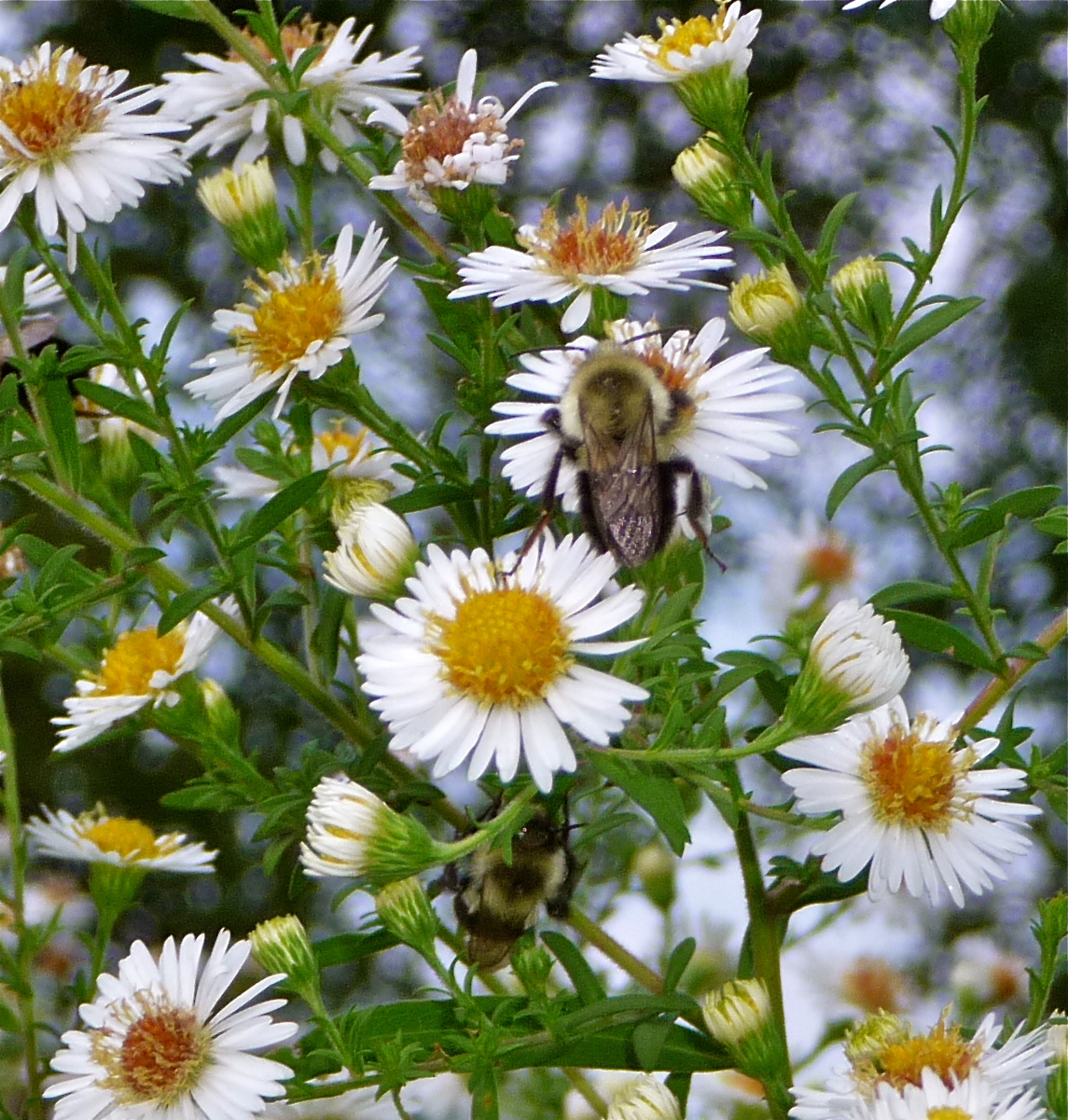
Wild Asters as Bee Lodge and Cafeteria

THIS is why you plant natives.  Even if you didn’t appreciate the fact that native plants are a huge chunk of a healthy, well-oiled ecology, you’d let the natives that spring up uninvited stay.  Because of the magic of the wildlife.  Native plants bring in all those things you see on the Discovery channel, but thought had been eradicated by DDT and suburban sprawl. You don’t even have to plant it. Just let ‘em go and they will come.

For example, I went out early one morning a couple of years ago with Rose, our black lab. Often while I’m waiting for her to finish her morning ablutions and her interminable search for snacks in the surrounding fields, I use the time to weed a little.  But this time, I stopped at the six-foot tall stand of wild white aster (Asteraceae), caught by the sight of a mid-sized bumblebee attached to the underside of one of the topmost flowers. He (she?) was sound asleep. I realized as I looked at the froth of flowers that the plants – volunteers all — were filled with sleeping bees. And not just one species. There were several different bumble-type bees, a few carpenter bees of which we have an overabundance, honeybees, and some other bees I’m too ignorant to i.d.  (Sadly no blue bees, which I had seen sleeping on the undersides of the raspberry leaves earlier in the season.). I dragged my husband, Gary, out to see.

“I thought bees all went back to their hives, or their tree stumps or the ground or the main support in the garage or whatever for the night,” he said, peering at one small bloom to which two different kinds of bees clung upside down. “It looks like they all fell asleep in the cafeteria.”

Bees asleep on volunteer wild asters in garden

The bees’ falling asleep in the cafeteria is apparently not that unusual; the link below will take you to a photo of a bee slumber party in a sunflower bloom. Watching the sun slowly warm and gradually wake the mixed-Apis crowd, I was not only delighted in a kind of ‘aw ain’t that cute’ way — sleeping bees are as cute as sleeping puppies though you’re not tempted to touch them. But I was struck by the democratic clustering of the different species. I’ve seen a pair of same-species bees crawl contentedly over each other on a single bloom, but object or leave in a huff when another species comes in to feed. But these were all ecumenically bedded down together as though at camp. Perhaps this is preaching to the choir — usually people who read garden articles are already entranced with bees and other pollinators — but even if I am, it’s nice to know we’re all in the same church.

http://homeofthebudds.typepad.com/homeofthebudds/2009/08/do-bees-sleep.html

Sunday Cooking Returns!

Moussaka and Cote de Brouilly

Since leaving the Chestertown Spy only last week, I’ve decided I still need to write about cooking, food, gardening, and environment — to say nothing of the wider world and the art of living.  So, I’m starting up Sunday Cooking again. It will begin next week — this week is temporary retirement — and I’ll need to figure out illustrations, links, the whole shebang.

BUT I hope those who hang in, and bring others — please, God — will be informed, amused, inspired, and encouraged.  ONWARD!

Here’s a link to what turned out to be almost three years of working for the Spy:

http://www.chestertownspy.com/food-garden/

The picture is one taken by my goddaughter, Anna Bowers, manager of the sublime cafe/wine bar in North Creek, NY in the heart of the Adirondacks.  She came down to do some R&R this weekend, shared the celebration of the marriage of two dear friends, one long-time and one new–who have embarked on the adventure of marriage late in life and with as much pleasure and excitement as if it were their first crush. I’m embarking on a new chapter too, and a new learning curve. Whoo hoo!

Anna, who writes for Vinoteca blog for the Times Union, has a few things to say about the weekend and because I know she’ll let me, I’ve stolen a big chunk of her blog here, but you can read the entire post via the link below:

Saturday, I was my godmother’s “plus one” to the wedding celebration for a 60+ bride and 80+ groom (Nancy, my godmother and writing mentor – not to mention fellow member of the blog-o-sphere – was the matron-of-honor).  Held on a working CSA farm on the eastern shore of Maryland, there were lots of delectable hors d’oeuvres, bubbly and wonderful guests.  But I must confess that I was looking forward to Nancy’s moussaka – waiting for us back home. Nancy lives in this utterly fabulous old house that, as a child, was filled with secret little staircases connecting slightly spooky (especially if it was dark and you had to use the upstairs bathroom by yourself) rooms.  It is one of those places that returns me to my childhood (in the best sense) as soon as I enter: warm lighting, dogs everywhere, a really big hug, something amazing to eat, great conversation, a sense of being loved and safe.

And Nancy, after years of taking care of those around her (including her adopted family – the Bowers), finally has the modern kitchen of her dreams. Designed to her specifications (heated floors!!), it allows guests to sit on one side of the kitchen island and chat while Nancy cooks up something yummy on the other side.  Or, as she said, allows her to sit and have a glass while someone else does the cooking.

The moussaka (check out Nancy’s recipe on The Chestertown Spy) was exactly what I needed after a late girls’ night of Friday: layers of ground lamb seasoned to perfection, eggplant and basil topped with a parmesan béchamel sauce, served piping hot on the sleek island countertop.  We paired it with the Potel Aviron Côte de Brouilly 2009.  It won out over the Dolcetto because Nancy and her husband had visited Brouilly in the first years of their marriage.  This Gamay is not, I repeat not, the Beaujolais you drank until you threw up when you were sixteen (true story).  It is elegant and mature, with a hint of spice (perhaps from the volcanic soil on which it is grown) and a lovely mouth that hints at chocolate and dark fruit. Really, the perfect companion to the earthy yet utterly decadent moussaka (did I mention the parmesan béchamel sauce . . .)

http://blog.timesunion.com/vinoteca/